Gold Sovereign vs Britannia: Which Should You Buy?
Short answer. Both are CGT-exempt British gold coins and both are superb ways to own investment-grade gold. But they serve different buyers, carry different premiums, and behave differently over time. This guide covers everything you need to decide.
Quick links
- Browse our graded proof sovereigns.
- Looking to sell? Start here: Sell to Us.
- Questions? Contact us.
Contents
1. The basics: what are they?
2. CGT exemption — the most important shared feature
3. Size, weight and gold content
4. Premiums over spot
5. Collector and graded coin potential
6. Liquidity and resale
7. Which should you buy?
8. FAQ
1. The basics: what are they?
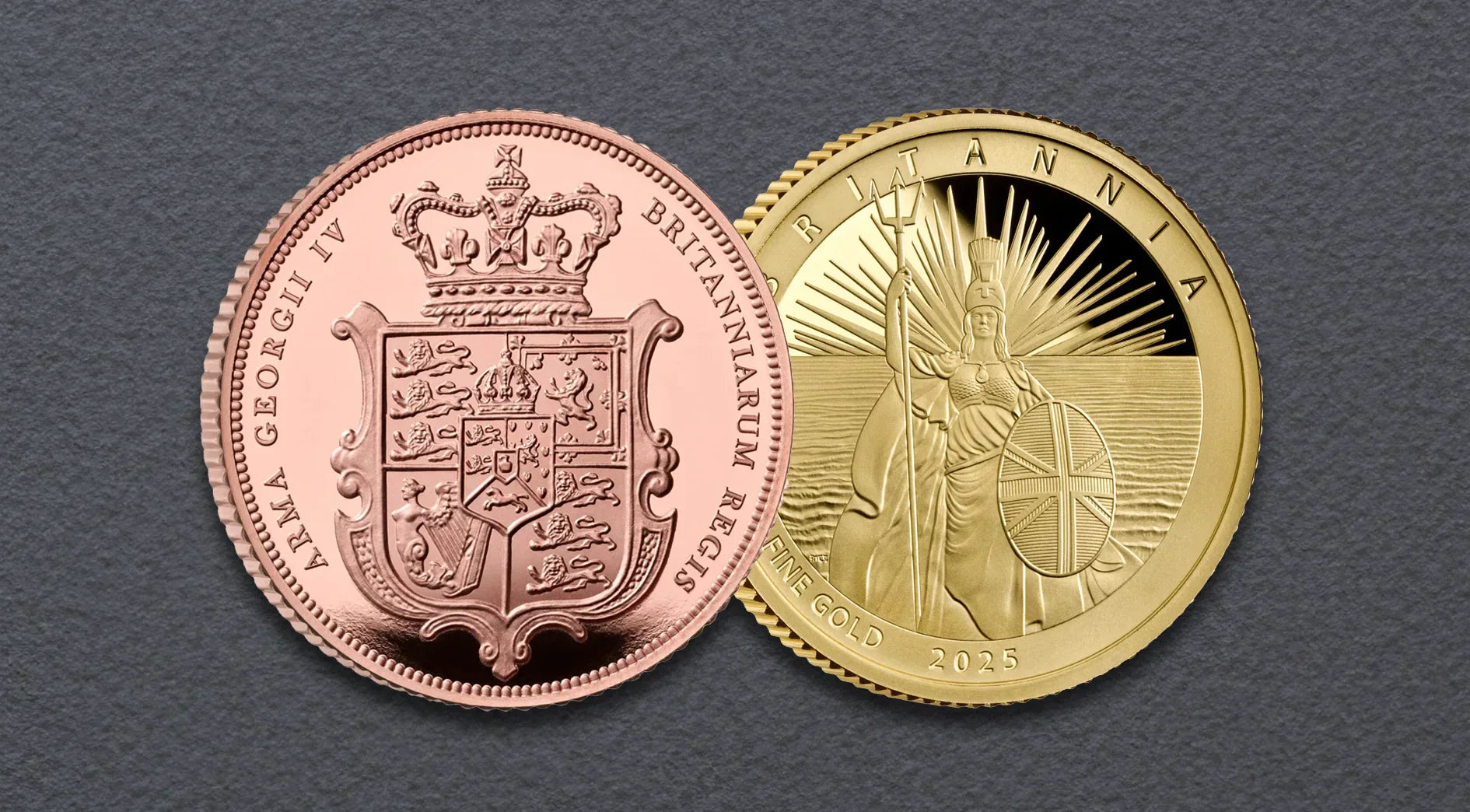
The Gold Sovereign is Britain's most historic gold coin. Struck continuously since 1817, it contains 0.2354 troy ounces of 22-carat (91.67%) gold in a coin 22.05mm across and weighing 7.98g. The reverse traditionally features Benedetto Pistrucci's iconic St George and the Dragon, though special commemorative designs appear regularly. Every modern proof sovereign is struck by the Royal Mint to the same exacting standard as its predecessors.
The Gold Britannia was introduced in 1987 as a dedicated bullion coin for investors. The current standard issue contains one full troy ounce of 24-carat (999.9) fine gold, making it one of the purest gold coins available from any sovereign mint. Britannia coins carry the face value of £100 and feature a rotating selection of Britannia designs on the reverse.
Both are legal tender in the United Kingdom. Both are produced by the Royal Mint. That is where many of the similarities end.
2. CGT exemption — the most important shared feature
The single most important fact about both coins for UK buyers: neither is subject to Capital Gains Tax on disposal. Under HMRC rules, all British legal tender coins are CGT-exempt, regardless of profit made on the sale. This applies to sovereigns and Britannias alike, in both bullion and proof formats.
For a UK buyer investing a meaningful sum in gold, this is enormously significant. A US investor selling a Gold Eagle or an Austrian Philharmonic would owe CGT on any gain above the annual allowance. A UK buyer selling either a sovereign or a Britannia owes nothing, whatever the profit.
This CGT-exempt status is one of the key reasons graded proof sovereigns in particular have attracted serious collector-investor interest. The combination of numismatic premium potential and full CGT exemption is almost unique in the investment world. You can read more in our guide to NGC and PCGS graded gold coins.
3. Size, weight and gold content
| Feature | Gold Sovereign | Gold Britannia (1oz) |
|---|---|---|
| Gold content | 0.2354 troy oz | 1.0000 troy oz |
| Purity | 22-carat (91.67%) | 24-carat (999.9) |
| Weight | 7.98g | 31.21g (bullion) / 33.63g (proof, incl. alloy) |
| Diameter | 22.05mm | 32.69mm |
| Face value | £1 | £100 |
| CGT exempt | Yes | Yes |
| VAT exempt | Yes (investment gold) | Yes (investment gold) |
The size difference matters practically. A sovereign is a small, elegant coin suited to discreet storage and gifting. A full-ounce Britannia is a substantial piece — impressive to hold, but larger to store securely. Half, quarter and tenth-ounce Britannias exist for buyers who want the Britannia format without committing to a full ounce at a time.
The Britannia's purity change: 22-carat to 24-carat
One detail that catches many buyers off guard: the Gold Britannia has not always been the 24-carat coin it is today. Understanding this change matters if you are buying or selling older issues.
When the Royal Mint launched the Britannia in 1987, it was struck in 22-carat gold (91.67% fine) — the same alloy used for the sovereign, and the same standard as the Krugerrand it was partly designed to compete with. The non-gold content was copper until 1989, then silver from 1990 onwards. This continued unchanged for 25 years, through every issue up to and including 2012.
In 2013, the Royal Mint switched the Britannia to 24-carat gold (999.9 fine), bringing it in line with the Canadian Maple Leaf, the Austrian Philharmonic, and other leading bullion coins that had long marketed themselves on purity. The move was driven by two practical factors. First, several major export markets — particularly in the Far East — have a strong cultural preference for pure gold and, in some cases, apply different tax treatment to coins below a certain fineness threshold. Australia, for example, only exempts gold from GST at 99.6% purity or above. By reaching 999.9 fine, the Britannia became far easier to sell internationally without tax complications for the buyer. Second, it aligned the Britannia with what the global investment market had come to expect from a modern premium bullion coin.
The physical result was a notably different coin. Because 24-carat gold is purer, less total metal is needed to deliver one troy ounce of fine gold. The pre-2013 Britannia weighed 34.05 grams; the post-2013 version weighs 31.10 grams. The 2013 issue briefly had a slightly wider diameter before returning to 32.69mm from 2014 onwards — earning the 2013 coin the nickname the "Britannia wafer" among collectors due to its thinner profile. Both versions contain exactly the same fine gold content: one troy ounce.
There is a useful footnote here for sovereign collectors. The sovereign has remained 22-carat throughout its entire modern history and shows no sign of changing. Proponents of 22-carat argue it produces a more durable coin — pure gold is a soft metal, susceptible to surface marks and scratches in everyday handling. The sovereign's alloy gives it resilience that contributes to the coin's longevity, which is part of why Victorian and Edwardian sovereigns still present well more than a century after striking. For proof coins sealed in NGC holders, this consideration is largely moot — but it is worth knowing when comparing the two series.
4. Premiums over spot
This is where the two coins diverge most sharply, and where the buying decision becomes more nuanced.
Bullion Britannias are the more efficient route to raw gold exposure. As a one-ounce coin with deep international recognition, the bullion Britannia typically trades at a relatively modest premium over the gold spot price — often in the range of 3–6% for standard bullion issues purchased from a reputable dealer. For buyers whose primary goal is to accumulate gold ounces at the lowest cost, this efficiency is attractive.
Bullion sovereigns also trade near spot, but their smaller size means the cost per ounce of gold is typically slightly higher than a full-ounce Britannia due to manufacturing costs spread over less metal. The advantage is granularity — at roughly a fifth of an ounce each, sovereigns allow you to liquidate in smaller increments without breaking a larger piece.
Proof sovereigns and proof Britannias both carry higher premiums over spot than their bullion counterparts, reflecting the additional striking quality, Royal Mint presentation, and collector demand. Proof Britannias in premium grades are collected, but the dedicated collector market for them is somewhat shallower than for proof sovereigns. The sovereign's 200-year history, its role as the quintessential British gold coin, and the enormous variety of portrait eras, designs and commemorative issues mean collector demand is consistently broader and deeper.
The most significant premium differential comes at the top of the grading scale. A proof sovereign graded PF70 Ultra Cameo by NGC can command premiums of 30–200%+ over its gold melt value, depending on year, design and population. A PF70 proof Britannia commands premiums too, but typically at a more modest level. The sovereign's collector infrastructure — NGC population reports, dedicated auction results, portrait-era collecting — supports stronger pricing at the top grade.
5. Collector and graded coin potential
If you are thinking beyond pure gold weight and into the collector-investor space, the sovereign has a structural advantage that is hard to overstate.
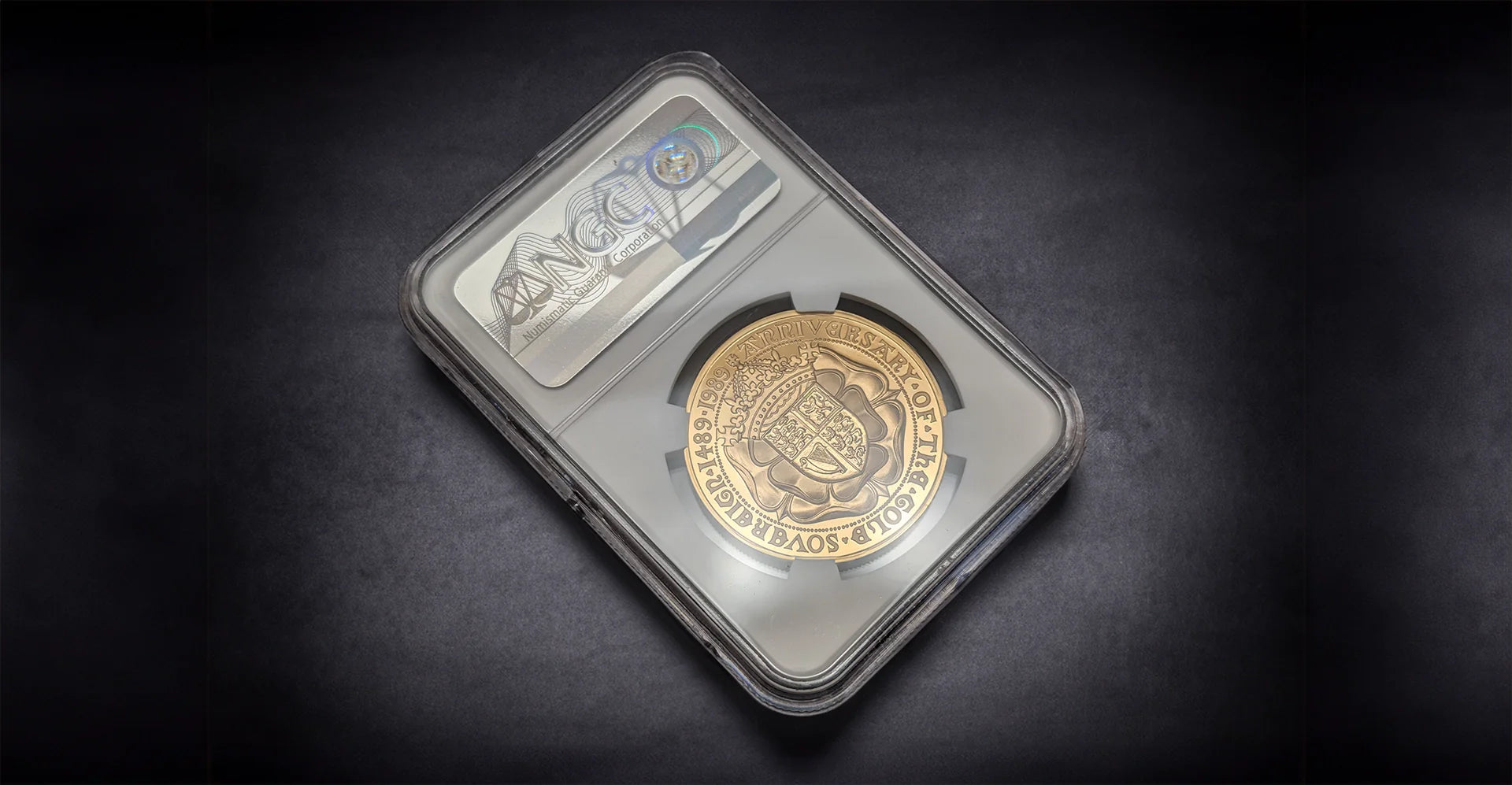
The sovereign has been struck under seven monarchs across more than two centuries. Collectors actively build type sets, portrait runs, date runs and anniversary year collections. This creates sustained demand for specific years and designs that is largely independent of the gold price. Coins like the 1989 Tudor Rose 500th Anniversary sovereign, the 2002 Shield Back, and the 2017 200th Anniversary carry premiums driven almost entirely by collector appetite rather than gold content.
Third-party grading by NGC and PCGS has transformed this market. A sovereign sealed in an NGC PF70 Ultra Cameo holder carries independently verified provenance and condition that a raw coin or even a Royal Mint presentation box cannot match. The holder confirms not just the grade but the metal composition, removing any uncertainty about authenticity. For high-value pieces, this certification has become the market standard.
The Britannia has its own collector following, particularly for the older pre-2013 reverse designs and the fine silver proof issues. But it lacks the sovereign's depth of portrait eras, commemorative variety, and centuries-long collecting tradition. For buyers who want the numismatic premium potential alongside their gold exposure, the sovereign is the stronger platform.
6. Liquidity and resale
Both coins are highly liquid within the UK and internationally. The sovereign is arguably the most recognised British gold coin globally — well known to dealers, auction houses, and private buyers from London to Hong Kong. The Britannia has strong international recognition too, particularly among investors who prioritise purity and the one-ounce standard.
For straightforward bullion sales, both coins can be sold quickly to any reputable UK dealer. Premiums achieved on resale will reflect current market conditions for each type.
For graded proof pieces, the sovereign again has the structural advantage. Dedicated specialist dealers — including Sovara Coins — focus specifically on the sovereign market. Specialist auction houses with strong track records in numismatic sovereigns provide an additional resale channel beyond dealer offers. A graded proof Britannia will typically trade through the same bullion or graded coin channels, but without the same depth of specialist buyer competition.
7. Which should you buy?
There is no single answer — it depends entirely on your goal.
Choose a bullion Britannia if:
- Your primary goal is maximum gold per pound spent, with CGT exemption.
- You want a universally recognised one-ounce coin for straightforward storage and resale.
- You are building a bullion position rather than a collection.
- You prefer 24-carat fine gold over the 22-carat alloy of the sovereign.
Choose a gold sovereign if:
- You want CGT-exempt gold with collector premium potential on top of metal value.
- You are interested in specific years, designs, or portrait eras with numismatic significance.
- You want a coin with a 200-year collecting tradition and deep specialist buyer market.
- You plan to hold long-term and want the optionality of both bullion and collector exit routes.
- You want granularity — the ability to sell individual coins without breaking a large position.
Choose a graded proof sovereign if:
- You want the full combination: CGT exemption, independently certified provenance, and access to collector premium upside.
- You are building a curated collection of top-grade examples from key years and designs.
- You want the strongest possible exit flexibility — specialist dealer, auction, or private sale.
The graded proof sovereign is the option Sovara Coins specialises in, and the one we believe offers the most compelling long-term combination of gold exposure, numismatic premium potential, and CGT-exempt status for the serious UK collector-investor. Explore our current selection of NGC-certified proof sovereigns, or see our Sixty-Nine Select PF69 range for exceptional value at the near-perfect grade.
If you are unsure which is right for your situation, contact us directly — we are happy to talk through your goals without any obligation.
8. FAQ
Are both gold sovereigns and Britannias CGT exempt?
Yes. Both are British legal tender and therefore exempt from Capital Gains Tax on disposal under UK tax law. This applies to bullion and proof versions of both coins.
Which coin has more gold — a sovereign or a Britannia?
A standard one-ounce Britannia contains approximately 4.25 times the gold of a single sovereign (1.000 troy oz vs 0.2354 troy oz). However, sovereigns are available in half, double, and five-pound denominations, and their smaller size offers useful granularity for incremental selling.
Is a proof sovereign better than a bullion sovereign?
They serve different purposes. A bullion sovereign is struck for gold content and trades near spot. A proof sovereign is struck to a much higher standard with polished dies, frosted relief and mirrored fields — it is a collector piece that carries a premium over its melt value and, when graded PF70 by NGC, can appreciate beyond the gold price. See our NGC grading guide for a full explanation.
Can I buy fractional Britannias instead of sovereigns for smaller investments?
Yes. The Royal Mint produces half-ounce, quarter-ounce and tenth-ounce Britannias, all CGT exempt. For very small amounts, a tenth-ounce Britannia (0.1 troy oz) is comparable in gold content to a half-sovereign. However, fractional coins typically carry a higher premium per ounce than full-ounce issues.
Which holds its value better over time?
Both track the gold price as their floor. Above that floor, collector demand for key sovereign years and top-grade certified examples has historically pushed prices well above melt value, particularly in rising gold markets. Past performance does not guarantee future results, and the collector premium for any specific coin depends on design, grade, population and demand at the time of sale.
Where can I sell gold sovereigns or Britannias?
Both can be sold to specialist dealers, through auction houses, or privately. For graded proof sovereigns, Sovara Coins offers same-day valuations and competitive offers. Visit our Sell to Us page to get started, or see our guides to selling inherited gold coins and selling sovereign sets.
Next steps.
1. Explore our current graded proof sovereigns.
2. See our Sixty-Nine Select PF69 range for best-value near-perfect grade examples.
3. Get a valuation via Sell to Us.
4. Ask a specialist — contact us any time.