How to Store and Insure Your Graded Gold Sovereigns: The Complete UK Guide
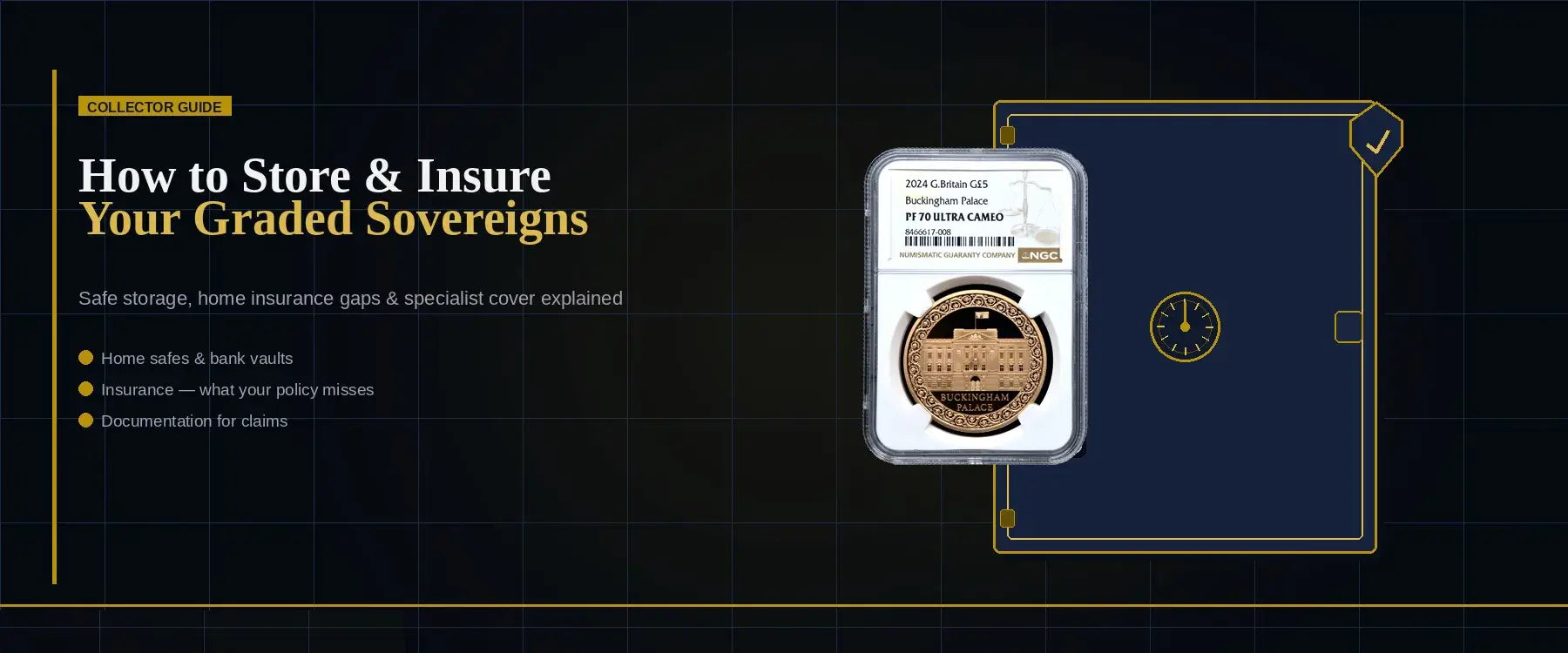
You've just taken delivery of a PF70 Ultra Cameo proof sovereign in its NGC slab. It's sitting on your desk. And the question immediately follows: where does it go now?
It's a question that surprisingly few guides address properly. Most numismatic content focuses on what to buy and why — very little covers what happens after the purchase. Yet for anyone holding hundreds or thousands of pounds of certified gold, storage and insurance aren't optional considerations. They're fundamental.
This guide covers everything UK collectors need to know: how slabs protect your coins, the right environment for long-term storage, physical security options at every budget, and how to make sure your collection is properly covered by insurance.
- Browse our latest graded sovereigns.
- Looking to sell? Start here: Sell to Us.
- Questions? Message us via Contact.
Contents
1. How much protection does a slab provide?
2. The right environment: temperature, humidity and light
3. Physical storage options
4. Insuring your collection
5. Documentation you need
6. Practical checklist for new collectors
7. FAQ
How Much Protection Does an NGC or PCGS Slab Actually Provide?
The short answer is: more than most collectors realise, but not unconditional protection.
An NGC or PCGS holder is manufactured from inert, archival-quality Surlyn plastic. It is airtight, meaning the coin inside is sealed against atmospheric humidity, airborne pollutants, and the oils from human skin — all of which can cause long-term toning or surface degradation on unprotected coins. The slab is also designed to absorb minor impacts, offering a degree of shock protection that a capsule or envelope cannot.
What a slab does not protect against is extreme heat, sustained crushing force, submersion in water, and — most relevantly — theft. The holder gives you condition assurance. It doesn't give you security.
One thing worth noting for collectors considering removing coins from their slabs: don't. Beyond the obvious risk of handling damage, cracking a slab to "liberate" a coin from its holder destroys the certification. A coin removed from its NGC or PCGS holder is, from that moment, an ungraded raw coin — regardless of its actual condition. The grade, the census registration, and the premium associated with them are all tied to the slab remaining intact.
The Right Environment: Temperature, Humidity and Light
Graded coins in sealed slabs are substantially more resistant to environmental damage than raw coins, but environment still matters — particularly for long-term storage over multiple decades.
Temperature: Aim for stable, cool and dry. The enemy of a coin collection is not temperature itself but temperature fluctuation, which causes expansion and contraction cycles that can, over years, affect the slab seal. A consistent 15–20°C is ideal. Avoid loft storage (extreme summer heat) and garages (damp and temperature swings).
Humidity: This matters more for raw coins than slabbed ones, but for peace of mind keep humidity below 55%. A cheap digital hygrometer (available for under £15) tells you the humidity in any storage area. Silica gel packets inside any storage container will absorb excess moisture.
Light: UV light causes fading on paper inserts and packaging over time. It won't damage the coin itself inside the slab, but for maintaining the aesthetic presentation of a graded collection, keep coins away from direct sunlight and fluorescent lighting. A dark storage environment is ideal.
Physical Storage Options: From Entry Level to Serious Collector
At Home: The Accessible Options
Safe deposit at home
For most collectors with up to 20–30 coins, a quality home safe is the first proper security step. Not all safes are equal — for coin storage you want:
- A fire rating of at least 30 minutes at 1,000°C (look for EN 1047-1 or equivalent certification)
- A cash rating — most safes carry a cash rating (typically £1,000–£10,000) which corresponds to the insurer's estimation of the contents value they will accept without question
- Physical anchoring to a wall or floor — a safe that can be carried out of your home provides very little security
Entry-level quality safes from brands like Chubb safes, Yale or Burton start from around £150–300 for a basic model. For collections worth £5,000+, budget £500–1,500 for something with meaningful security credentials.
Purpose-built coin storage
Within any safe, slabs stack neatly in purpose-made coin slab boxes — plastic trays designed to hold NGC or PCGS holders upright. These are available from coin supplies retailers for a few pounds each and make organising a collection significantly easier. Storing slabs loose in a bag or box risks scratching the holders, which while it doesn't affect the coin affects the presentation.
Bank Safe Deposit Box
For collections of meaningful value — particularly anything over £10,000 — a bank safe deposit box is worth serious consideration. Costs vary by bank and box size but typically run from £50–250 per year in the UK. Major high street banks including Barclays, Lloyds and NatWest offer this service, though availability has reduced in recent years and some branches have closed their facilities.
The advantages are considerable: bank-grade physical security, environmental consistency, and the peace of mind of knowing your collection is not in your home. The disadvantage is access — you can only view your coins during banking hours, which becomes relevant if you are an active buyer and seller.
Professional Vault Storage
For serious collectors or those holding investment-grade gold in quantity, professional vault storage through a specialist provider offers the highest security available. Companies including Merrion Vaults and The Safe House offer allocated storage in Class 3 vaults with full insurance included in the fee.
Costs typically start from around £50–100 per year for small quantities, scaling with the value held. This option is most relevant for collectors who also view their coins as investment assets and want storage costs to reflect the value of what they hold.
Insuring Your Graded Gold Sovereign Collection: What You Need to Know
This is the area where most collectors are significantly underinsured — often without realising it.
Does Your Home Insurance Cover Coins?
Possibly, but almost certainly not adequately. Standard home contents insurance policies typically include a single article limit — a maximum payout for any one item — which is often £1,500–2,500. For a PF70 sovereign worth £3,000–£8,000, that gap matters.
Most standard policies also have an aggregate limit for valuables (jewellery, coins, artwork, watches) that is a percentage of the total sum insured. If your contents policy is for £50,000 of general contents, your valuables limit might be £5,000–10,000 total — which a modest coin collection can exceed quickly.
The further complication is that many standard home contents policies exclude or restrict coverage for:
- Items of numismatic value
- Precious metals in coin or bar form
- Items kept in outbuildings or detached garages
- Theft without signs of forced entry
Before assuming you're covered, read your policy documents carefully — or call your insurer and ask them directly whether your coin collection is covered and up to what value.
Specialist Collector Insurance
The correct solution for any collector with meaningful holdings is a specialist collector insurance policy. Several UK providers offer this:
Aon Collector Insurance — one of the most established providers for numismatic collections in the UK. Covers coins, banknotes and precious metals with agreed values, worldwide coverage, and no single item limit restrictions.
Hiscox — offers specialist high-value contents and collection insurance, widely used for art, jewellery and collectibles.
T H March — specialist collector insurance used extensively by the numismatic community, offering agreed value policies for coin collections.
The key difference with specialist collector policies is agreed value coverage — you and the insurer agree the value of each item at the point of taking out the policy, and that is what you receive in the event of a claim. Standard home insurance pays market value at time of loss, which is both harder to establish and often lower than what you paid or what you would need to replace the item.
What Documentation Do You Need?
To insure a graded coin collection properly you will need:
Purchase receipts — keep these permanently. A receipt showing what you paid, from whom, and when is your primary evidence of ownership and value.
NGC/PCGS certification numbers — these are your proof of authenticity and grade. Keep a record of every cert number in a separate location from the coins themselves. A simple spreadsheet with coin description, cert number, purchase price and current estimated value is sufficient.
Photographs — photograph each coin and slab before storing. In the event of theft, being able to provide a photograph and cert number to police and insurers significantly improves the chances of recovery and an uncontested claim.
Current valuations — for higher value pieces, a written valuation from a reputable dealer every few years helps establish current market value, particularly if a coin has appreciated significantly since purchase.
A Practical Checklist for New Collectors
If you've recently purchased your first graded sovereign and want to make sure you're doing things properly, here's a straightforward checklist:
- Keep your purchase receipt somewhere safe and separate from the coin
- Note down the NGC or PCGS cert number and store it digitally (email it to yourself if nothing else)
- Photograph the coin and slab before putting it away
- Check your home contents insurance policy for single item limits and valuables exclusions
- Consider a specialist collector policy if your total collection value exceeds your home insurance valuables limit
- Store in a cool, dry, dark environment away from temperature extremes
- If the value justifies it, invest in a quality anchored safe — or consider a bank safe deposit box
The NGC slab does an extraordinary job of protecting the coin inside it. The rest — security, insurance, documentation — is down to you.
Ready to add to your collection? Browse our latest graded gold sovereigns. If you have coins to sell we can make a firm offer via Sell to Us.
FAQ
Can I store graded coins in a standard filing cabinet or drawer?
You can, but it offers no security and limited environmental protection. For anything of value, a proper storage solution is worth the investment.
Should I remove coins from their slabs for display?
No. Removing a coin from its NGC or PCGS holder permanently destroys the certification. If you want to display a coin, display it in the slab — purpose-made slab display stands are widely available and keep the coin fully protected.
Does the NGC holder need any maintenance?
No. The holder is designed to be permanent and maintenance-free. Simply keep it away from sharp objects that could scratch the plastic surface.
What happens if my slab is cracked or damaged?
If the slab is cracked but the coin is undamaged, NGC and PCGS both offer a reholder service — the coin is sent back, re-examined, and placed in a new holder. Contact them directly for current pricing and procedures.
How often should I have my collection valued for insurance purposes?
Every two to three years as a minimum, or whenever gold prices or the numismatic market has moved significantly. Given the gold price moves of recent years, a valuation from two years ago may now be substantially below current market values.
Is a home safe enough security for a valuable coin collection?
For collections up to around £10,000, a quality anchored safe with a solid cash rating provides reasonable protection. Above that level, a bank safe deposit box or professional vault is worth serious consideration — both for security and to satisfy insurance requirements.
Next steps.
1. Explore our current graded sovereigns.
2. Get a valuation or offer via Sell to Us.
3. Ask a specialist — use Contact.