When it comes time to liquidate gold or silver coins, most people turn to Google. A quick search for "sell gold coins" or "best price for sovereign gold" brings up high-profile bullion operations occupying the top spots. It is easy to assume that because a company ranks #1 on search engines, they must offer the best payouts.
In reality, relying solely on high-volume bullion buyers for premium, boxed proof, or certified slabbed coins often results in leaving significant money on the table.
The SEO Trap: Top Search Ranking ≠ Best Payoff
High-volume bullion dealers spend massive budgets to dominate search results for broad terms. Their core business model is built around speed, scale, and high-volume metal turnover.
To process hundreds of transactions daily, these platforms use automated pricing engines. You type in a coin type, and their system instantly calculates an offer based strictly on raw melt weight:
The Bullion Formula: Fine Weight × Current Spot Price − Dealer Margin = Your Offer
While this automated model works reasonably well for standard, circulated investment bullion, it completely fails to account for numismatic value when evaluating collectible coins.
What Scrap & Bullion Dealers Melt Away
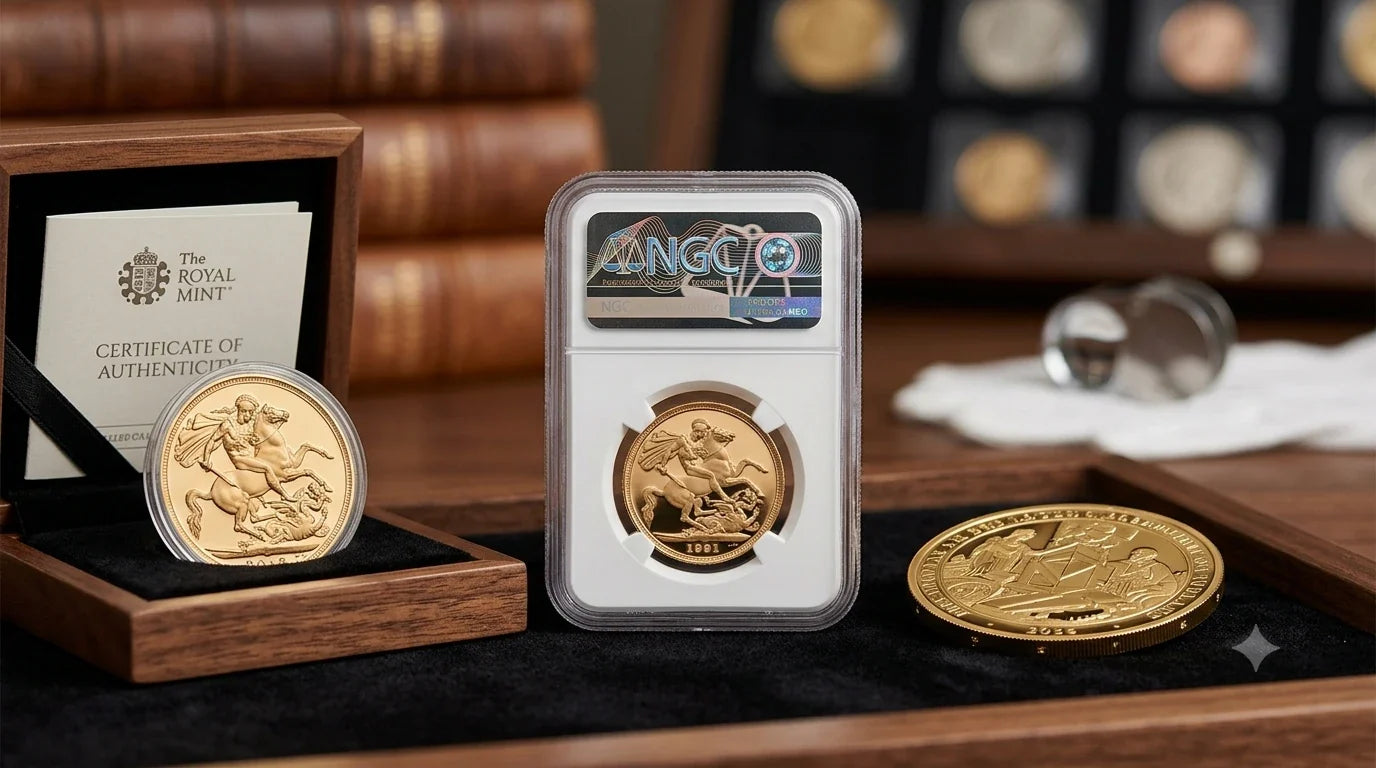
When you submit a piece like a Royal Mint Proof Sovereign in its original box with Certificate of Authenticity (COA) or an NGC/PCGS certified coin to a high-volume bullion firm, their system typically treats it as standard scrap metal.
Here is what automated buy-back algorithms routinely ignore:
- Original Mint Packaging & Packaging COAs: Royal Mint wooden display cases, leatherette boxes, and numbered certificates carry real market value for collectors.
- Low Mintage Numbers & Special Editions: Commemorative strikes, anniversary years, and reverse designs (such as the 1989 500th Anniversary Sovereign or 2012 Jubilee Sovereign) command strong collector premiums above gold content.
- Certified Grading (NGC & PCGS Slabs): Third-party authentication guarantees state of preservation (e.g., MS69, MS70, PF70 Ultra Cameo). A bullion dealer's automated quote pays zero premium for high-grade encapsulation.
The Real Cost: How Much Are You Missing Out On?
Below is a comparison showing typical buy quotes from automated bullion buyers versus real market value offered by specialist numismatic buyers:
| Coin Category | Typical Bullion Dealer Offer | Specialist Numismatic Valuation | Difference Lost |
|---|---|---|---|
|
Standard Bullion Sovereign (Circulated / Common Date) |
95% – 97% of Spot Price | 97% – 100% of Spot Price | Minimal difference |
|
Royal Mint Proof Sovereign (With Box & COA) |
95% – 97% of Spot Price (Treats as raw metal) |
Spot Price + 15% to 35%+ Premium | £100 – £300+ Lost |
|
NGC/PCGS Graded PF70 Proof (Top Population Grade) |
95% – 97% of Spot Price (Ignores grade completely) |
Full Collector Market Value | £300 – £1,000+ Lost |
When a bullion buyer purchases a proof or high-grade piece at spot price, they rarely melt it down. Instead, they unbox or re-sell those items to specialist coin dealers at true market value—pocketing the premium that belonged to the original seller.
How to Protect Your Coin Value Before Selling
- Identify Your Strike Type: Check whether your coin has a standard uncirculated finish or a mirror-like Proof finish. Proof coins are struck multiple times using polished dies and are produced in strictly limited quantities.
- Keep Everything Together: Never discard original outer boxes, velvet cases, or paper certificates. For slabbed coins, never crack open an NGC or PCGS holder.
- Seek an Itemised Numismatic Valuation: Avoid generic "cash for gold" drop-down tools. Request a tailored appraisal from a dedicated numismatist who evaluates each item based on rarity, condition, and market demand.
Don't let volume dealers buy your collectible coins at scrap prices. Get an accurate, itemised valuation based on genuine collector market value.
Request a Specialist Appraisal