The Illusion of Numbers: What Truly Defines "Rarity" in Modern Numismatics?
In the world of gold sovereigns and premium numismatics, we throw the word "rare" around daily. But rarity is arguably the most misunderstood metric in coin collecting. If you rely solely on mintage figures to dictate a coin's value, you are only looking at half the equation.
Rarity is subjective. It is a complex, ever-shifting matrix of supply, intense collector demand, historical weight, and sheer physical perfection. To understand why certain coins command astronomical premiums while others trade near their gold weight, we must look past the spreadsheets.
High Mintage, High Premium: The Power of "Condition" and "Halo"
Let’s start by debunking the biggest myth in coin collecting: High mintage equals low premium. When demand or grading difficulty outpaces supply, even common coins become expensive treasures.
-
Example 1: The 1989 500th Anniversary Sovereign (The "Halo Effect")
The Royal Mint produced over 23,000 of these proof coins featuring Bernard Sindall’s magnificent Tudor Rose. In the realm of modern proofs, 23,000 is a massive, highly accessible mintage. Yet, if you want a 1989 Sovereign in a flawless NGC PF70, expect to pay upwards of £2,300. Why? Because it is a "Halo Coin." It was the first commemorative sovereign in history. The demand is so intense that a supply of 23,000 simply cannot satisfy the global market. Demand creates the rarity.
-
Example 2: The 1979 Proof Sovereign (Condition Rarity)
The Mint struck a colossal 50,000+ of these in 1979. You can buy a raw, uncertified example today for just a slight margin over the gold spot price. But try finding one graded PF70 Ultra Cameo. In 1979, the Mint's striking technology often left minor milk spots or hairlines. A 1979 Proof Sovereign that achieves a perfect 70 grade is a statistical anomaly, which is why a PF70 example can command over £3,000. The coin isn't rare; the perfection is rare.
-
Example 3: The 1957 Bullion Sovereign (Survival Rarity)
The very first bullion sovereign of Elizabeth II's reign had a massive mintage of over 2,000,000. Because it was a bullion issue, these coins were thrown into giant canvas bags, causing them to clink together and scratch. While a standard circulated 1957 trades at bullion value, an example graded in the "Top Pop" of MS66 or MS67 is virtually extinct. Collectors will pay thousands for this common coin simply because it managed to survive the minting process without a scratch.
Low Mintage, Low Premium: The Danger of "Apathy"
Now, let's flip the script: Does a microscopic mintage guarantee a massive premium? Absolutely not. If a coin lacks a compelling narrative or dedicated collector base, its rarity simply doesn't matter.
-
Example 1: The 2013 & 2014 Proof £5 (Quintuple Sovereigns)
A novice investor might look at the tiny mintage of the 2013 and 2014 Proof £5 coins (often well under 1,500 pieces) and assume they carry a 100% premium over spot. The reality is quite different. While they are stunning pieces, they feature the standard St. George and the Dragon design during non-anniversary years. The collector pool actively hunting for a specifically 2013 £5 is relatively small. Even in Top Pop grades, low supply meets low localized demand, keeping the premium grounded.
-
Example 2: Modern Quarter Sovereigns (e.g., 2011 or 2015 Proofs)
Quarter Sovereigns routinely have incredibly low mintages, sometimes hovering around 2,000 to 3,000 pieces. By the numbers, they are significantly "rarer" than the 1989 Tudor Rose. However, the market for standalone fractional sovereigns is very niche. Most collectors want Full or Double Sovereigns. Because of this lack of broad demand, you can often pick up these "Top Pop" fractional coins for a tiny margin over their initial issue price.
The Three Pillars of Numismatic Premium
To evaluate a coin's true market strength, we measure it against three criteria:
- 1. Absolute Rarity (The Mintage): How many were struck on day one?
- 2. Contextual Rarity (The Story & Demand): Is it a one-year design? An anniversary? A famous engraver?
- 3. Condition Rarity (The Grade): How many survived in flawless condition?
"A coin is only as common as its highest grade. A million minted means nothing if only five achieved perfection."
The Takeaway for Collectors
When you are building a high-end portfolio, don't just ask, "How many were made?" Ask what makes the coin special. Is it a Halo coin? Does it have a unique historical context? Is it a Top Pop condition rarity?
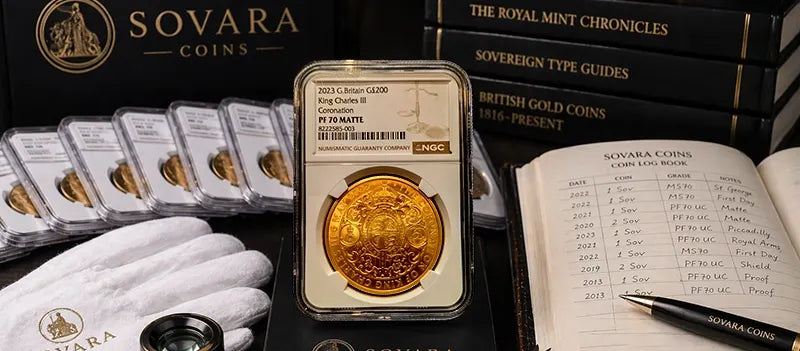
Our current favourite rarity for sale? The 2023 Coronation 1oz Gold Proof Coin.
At Sovara Coins, we don't just sell gold weight; we curate portfolios based on these exact metrics. We seek out the condition rarities, the "Top Pop" grades, and the Halo designs that outpace the standard bullion market.