Royal Mint Coin Sizes Explained: The Complete Guide to Sovereigns, Britannias & Silver Proofs
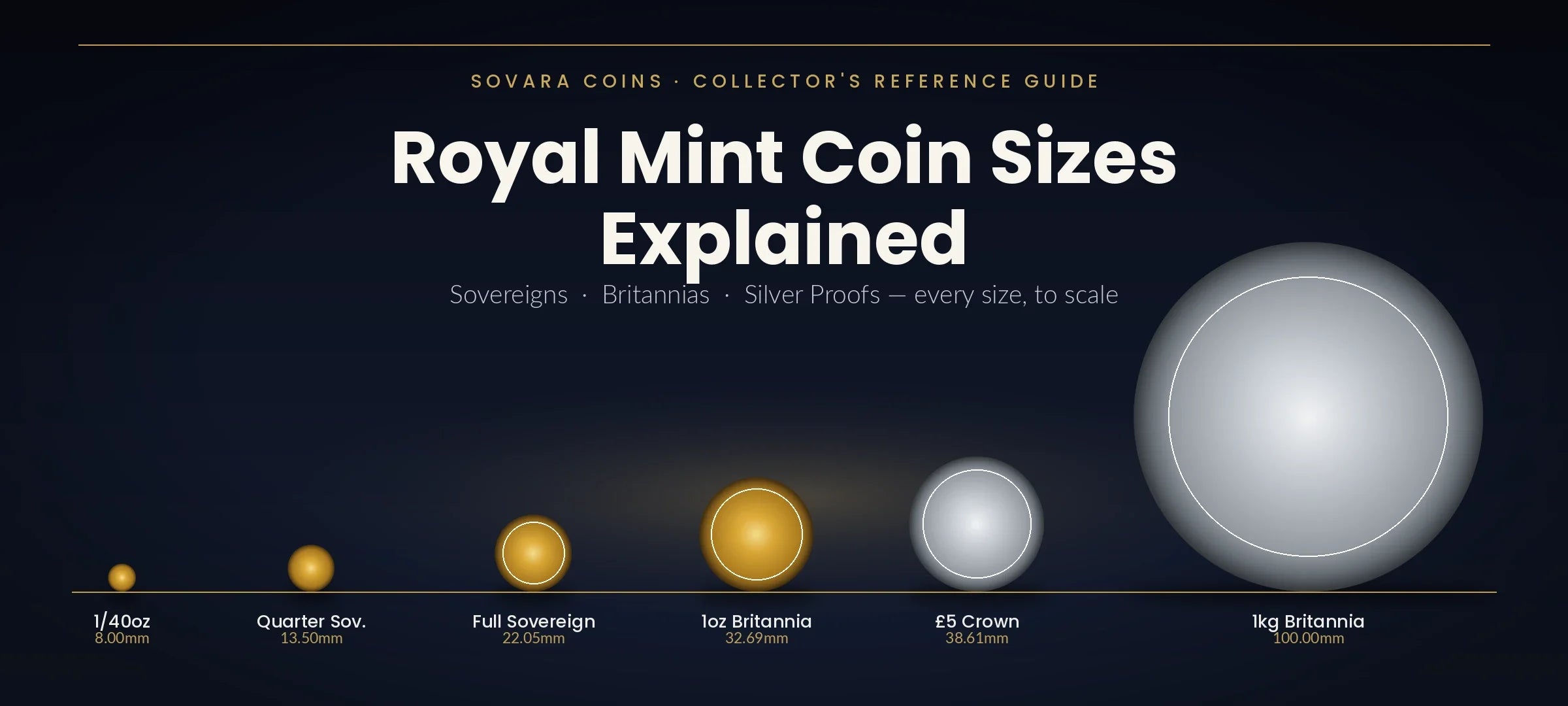
Once you move beyond sovereigns, Royal Mint coin sizes can get confusing fast. A "1oz" gold Britannia and a "1oz" silver Britannia aren't the same diameter. A £1 face value can mean the coin in your pocket, a full sovereign, or a tiny 1/20oz gold coin. And a "kilo" coin is a genuinely different object to hold than a "1/40oz" coin, which is smaller than a shirt button.
This guide is a single reference point for the sizes, weights and specifications of the coins collectors encounter most often from The Royal Mint: the sovereign family, gold and silver Britannias from 1/40oz right up to the one kilogram coin, platinum Britannias, and the silver proof crowns and circulating denominations that regularly appear in proof sets. Every figure below is drawn from The Royal Mint's own published specifications, so you can use this page as a quick lookup whenever a listing mentions a size or weight you don't immediately recognise.
Contents
- Quick reference: every Royal Mint coin size at a glance
- The sovereign family (quarter to £5)
- Gold Britannia coins: 1/40oz to 5oz
- Silver Britannia coins: 1/40oz to 1 kilogram
- Platinum Britannia coins
- Silver proof crowns and circulating denominations
- Bullion, Brilliant Uncirculated and Proof: what the finish means
- Why coin size matters for collectors
- Which size is right for you?
- Common sizing mistakes and misconceptions
- Final thoughts
- FAQ
Quick reference: every Royal Mint coin size at a glance
This table pulls together the most commonly collected Royal Mint denominations so you can compare across metals and ranges in one place. Diameters and weights reflect the current specification for each coin; where a coin's exact size can vary slightly by year or edition, this is noted underneath.
| Coin | Metal | Diameter | Weight | Face value |
|---|---|---|---|---|
| Quarter Sovereign | 22ct gold (.9167) | 13.50mm | 2.00g | 25p |
| Half Sovereign | 22ct gold (.9167) | 19.30mm | 3.99g | 50p |
| Full Sovereign | 22ct gold (.9167) | 22.05mm | 7.98g | £1 |
| Double Sovereign | 22ct gold (.9167) | 28.40mm | 15.98g | £2 |
| £5 Sovereign | 22ct gold (.9167) | 38.61mm | 39.94g | £5 |
| Gold Britannia 1/40oz | 24ct gold (.9999) | 8.00mm | 0.80g | 50p |
| Gold Britannia 1/20oz | 24ct gold (.9999) | 12.00mm | 1.58g | £1 |
| Gold Britannia 1/10oz | 24ct gold (.9999) | 16.50mm | 3.13g | £10 |
| Gold Britannia 1/4oz | 24ct gold (.9999) | 22.00mm | 7.86g | £25 |
| Gold Britannia 1/2oz | 24ct gold (.9999) | 27.00mm | 15.60g | £50 |
| Gold Britannia 1oz | 24ct gold (.9999) | 32.69mm | 31.10g | £100 |
| Gold Britannia 5oz | 24ct gold (.9999) | 50.00mm | 156.30g | £500 |
| Silver Britannia 1/40oz | .999 fine silver | 8.00mm | 0.80g | 5p |
| Silver Britannia 1/20oz | .999 fine silver | 12.00mm | 1.58g | 10p |
| Silver Britannia 1/4oz | .999 fine silver | 22.00mm | 7.86g | 50p |
| Silver Britannia 1oz | .999 fine silver | 38.61mm | 31.21g | £2 |
| Silver Britannia 2oz | .999 fine silver | 40.00mm | 62.86g | £5 |
| Silver Britannia 5oz | .999 fine silver | 63.75mm | ~155.5g | £10 |
| Silver Britannia 10oz | .999 fine silver | 89.00mm | ~311g | £10 |
| Silver Britannia 1kg | .999 fine silver | 100.00mm | 1,000g | £500 |
| Platinum Britannia 1oz | .9995 fine platinum | 32.69mm | 31.21g | £100 |
| £5 Crown (silver proof) | .925 sterling silver | 38.61mm | 28.28g | £5 |
| £5 Crown (gold proof) | 22ct gold (.917) | 38.61mm | 39.94g | £5 |
| £2 coin | Nickel-brass / cupro-nickel | 28.40mm | 12.00g | £2 |
| £1 coin (12-sided) | Nickel-brass / nickel-plated brass | 23.43mm** | 8.75g | £1 |
| 50p coin | Cupro-nickel | 27.30mm** | 8.00g | 50p |
The £1 and 50p coins are not round, so "diameter" refers to the width across flats/points on their equilateral-curve or 12-sided shapes rather than a true circular diameter.
The sovereign family (quarter to £5)
The sovereign is Britain's most famous gold coin, struck in 22 carat (.9167) gold since its modern revival in 1817. The modern range runs from the quarter sovereign up to the £5 sovereign, and we've covered this family in full detail in a dedicated guide: Sovereign Sizes Explained - Quarter to £5 Sovereigns Guide. The headline figures are repeated in the quick reference table above for convenience, but if you want the full breakdown of history, proof set composition and which size suits which type of collector, that guide covers it in depth.
Gold Britannia coins: 1/40oz to 5oz
The Britannia is The Royal Mint's flagship gold bullion coin, struck since 1987 and featuring Britannia on the reverse. Since 2013, gold Britannias have been struck in 999.9 fine gold (24 carat), a step up in purity from the 22 carat standard used from 1987 to 2012. This matters for collectors comparing older and newer coins: a pre-2013 1oz gold Britannia weighs 34.05g in total because it contains 22 carat alloy, while a 2014-onwards 1oz coin weighs 31.10g because it's almost pure gold with no alloy padding.
The modern gold Britannia range runs across seven sizes:
1/40oz Gold Britannia
At just 8mm across and 0.80g in weight, the 1/40oz is the smallest coin The Royal Mint produces. It carries a face value of 50p and is usually sold as part of fractional sets rather than as a standalone bullion product. Its size makes it easy to overlook in a listing, so always check the exact weight before assuming a small gold coin is a 1/10oz or 1/4oz piece.
1/20oz Gold Britannia
At 12mm and 1.58g, the 1/20oz carries a £1 face value - the same nominal denomination as a full sovereign or the £1 coin in your pocket, despite being a completely different coin. Like the 1/40oz, it was introduced in 2013 alongside the 5oz coin as part of an expansion of the Britannia range's fractional offering.
1/10oz Gold Britannia
The 1/10oz measures 16.50mm and weighs 3.13g, with a face value of £10. This size has existed since the original 1987 launch of the gold Britannia range (albeit at a slightly different weight before the 2013 purity change) and remains a popular lower-cost entry point into gold Britannia collecting.
1/4oz Gold Britannia
At 22mm and 7.86g, the 1/4oz Britannia carries a £25 face value. It offers a useful middle ground - noticeably more substantial than the smaller fractional sizes, without the cost of a half or full ounce coin.
1/2oz Gold Britannia
The 1/2oz measures 27mm and weighs 15.60g, with a £50 face value. This size is popular with collectors who want real heft and presence without stepping up to a full ounce.
1oz Gold Britannia
The standard 1oz Britannia is the benchmark of the range: 32.69mm in diameter, 31.10g in weight, and a face value of £100. It's the most widely traded and recognised size, produced every year since 1987 in unlimited bullion mintage since 2013.
5oz Gold Britannia
The largest gold Britannia is the 5oz coin: 50.00mm in diameter, 156.30g in weight, with a face value of £500. It's issued as a limited proof or commemorative piece rather than a standard annual bullion release - mintages as low as 90 pieces have been recorded - so availability is far more restricted than the smaller sizes.
Silver Britannia coins: 1/40oz to 1 kilogram
Silver Britannias have been struck since 1997. Like their gold counterparts, the specification changed in 2013: coins from 1997 to 2012 were struck in .958 fine Britannia silver at 40.00mm and 32.45g, while coins from 2013 onwards are struck in .999 fine silver at 38.61mm and 31.21g for the standard 1oz size. This is one of the most useful facts to know when buying older silver Britannias, since the two eras are genuinely different specifications, not just different designs.
One interesting pattern across the range: the smallest fractional Britannias (1/40oz, 1/20oz and 1/4oz) are struck to identical diameters and weights in both gold and silver, since the "1/40oz" or "1/20oz" designation is a fraction of a troy ounce by weight, not by size - it's only at 1oz and above that gold and silver Britannias diverge into their own separate, metal-specific dimensions.
1/40oz Silver Britannia
8.00mm, 0.80g, face value 5p. The smallest coin in the silver range, typically sold as part of a themed fractional proof set.
1/20oz Silver Britannia
12.00mm, 1.58g, face value 10p.
1/4oz Silver Britannia
22.00mm, 7.86g, face value 50p.
1/10oz and 1/2oz Silver Britannia
The Royal Mint has also issued 1/10oz (face value 20p) and 1/2oz (face value £1) silver Britannias in various years, based on the same fraction-of-a-troy-ounce weight structure as the rest of the range. These two sizes are issued less consistently than the others, so it's worth checking the specification on the individual listing before buying, as exact dimensions can vary by release.
1oz Silver Britannia
The standard 1oz coin measures 38.61mm and weighs 31.21g, with a face value of £2. This is the most widely collected and traded silver Britannia size, and the one most commonly seen in bullion tubes, monster boxes and annual proof releases.
2oz Silver Britannia
40.00mm in diameter and 62.86g in weight, with a face value of £5. The 2oz size is generally issued as a proof or commemorative piece rather than a standard bullion product.
5oz Silver Britannia
63.75mm and roughly 155.5g, with a face value of £10. Despite being five times the metal content of the 1oz coin, the 5oz is not five times the diameter - it's a noticeably chunkier, heavier piece rather than simply a wider one.
10oz Silver Britannia
89.00mm in diameter, around 311g in weight, and a face value of £10 - the same nominal face value as the 5oz coin. This is a reminder that face values on larger bullion coins don't scale proportionally with size or metal content; they're a legal tender designation set by The Royal Mint, not a reflection of the coin's silver value.
1 kilogram Silver Britannia
The largest coin in the silver Britannia range: 100.00mm across, exactly 1,000g (32.15 troy oz) in weight, and a £500 face value. At 10cm in diameter, this is a genuinely substantial piece, roughly the size of a small saucer, and is bought almost exclusively as a display or investment piece rather than for a standard collection tray.
Platinum Britannia coins
Platinum Britannias have been struck since 2018, in .9995 fine platinum. The standard 1oz coin measures 32.69mm - the same diameter as the 1oz gold Britannia - and weighs approximately 31.21g, with a face value of £100. The Royal Mint has occasionally issued fractional platinum Britannias (1/10oz, 1/4oz and 1/2oz) in limited numbers, following the same fraction-of-a-troy-ounce weight structure as the gold and silver ranges, though these fractional platinum sizes are issued far less consistently and in much smaller numbers than the standard 1oz coin.
Silver proof crowns and circulating denominations
Alongside the Britannia and sovereign ranges, The Royal Mint regularly strikes silver proof versions of the UK's crown-sized commemorative coin and, less frequently, of standard circulating denominations. These are especially common in jubilee, coronation, anniversary and memorial releases.
The £5 Crown
The modern £5 coin (sometimes still called a "crown," continuing a name used for this size and denomination since the 17th century) has a fixed diameter of 38.61mm across every version The Royal Mint produces:
| Version | Alloy | Weight |
|---|---|---|
| Cupro-nickel Brilliant Uncirculated | Cupro-nickel | 28.28g |
| Sterling silver proof | .925 silver | 28.28g |
| Silver piedfort proof | .925 silver, double thickness | 56.56g |
| Gold proof | 22ct gold (.917) | 39.94g |
The 38.61mm diameter has remained essentially unchanged across this coin's specification since the 17th century, which is why it lines up exactly with the diameter of the modern £5 sovereign and the 1oz silver Britannia - all three share this size, even though they are entirely different coins with different histories and face values.
£2, £1 and 50p silver proofs
The Royal Mint also periodically strikes silver proof versions of standard circulating denominations for commemorative releases - Jane Austen and WWI Aviation £2 coins, 50th anniversary 50p designs, and similar. These silver proof versions are struck to the same diameter as the coin you'd find in your change, in fine or sterling silver rather than the base-metal alloys used for circulation:
- £2 coin: 28.40mm diameter, 12.00g in its standard nickel-brass/cupro-nickel bimetallic circulating form.
- £1 coin (12-sided, since 2017): 23.43mm across the points, 8.75g in its standard nickel-brass/nickel-plated-brass circulating form.
- 50p coin: 27.30mm across the flats of its equilateral-curve heptagon shape, 8.00g in its standard cupro-nickel circulating form.
Silver proof editions carry a different total weight to their circulating counterparts because silver has a different density to the base-metal alloys used day-to-day, so always check the individual coin's certificate or Royal Mint listing for the exact silver proof weight rather than assuming it matches the circulating figure.
Bullion, Brilliant Uncirculated and Proof: what the finish means
Size and weight are only half the picture. The same denomination can be struck to different finishes, and this affects both appearance and price:
Bullion coins are struck for investment purposes, with a simple, functional finish and no special packaging. These are typically the cheapest way to buy a given size and metal content.
Brilliant Uncirculated (BU) coins are struck with a sharper finish than bullion and are usually presented in protective packaging, sitting between bullion and proof in both quality and price.
Proof coins are struck using specially polished dies, multiple strikes and hand-finished planchets to produce a mirrored background with a frosted design - the "cameo" effect. Proof coins are the finish most associated with collector sets, low mintages and the PF70/PR70 grading you'll see referenced on graded coin listings.
Why coin size matters for collectors
Beyond simple curiosity, understanding size matters for three practical reasons. First, it affects value: larger coins generally cost more because they contain more precious metal, but rarity, mintage and grade can outweigh size when it comes to collector premiums. Second, it affects display and handling: a kilo silver coin needs a very different storage and display approach to a 1/40oz gold coin you could lose in a coat pocket. Third, it affects how a design reads: larger coins give engravers more room to work with, which is why commemorative and anniversary designs are often reserved for double sovereigns, £5 coins and the larger Britannia sizes rather than the smallest fractional pieces.
Which size is right for you?
If you want a classic, widely recognised gold coin at a sensible price point, the full sovereign or the 1oz gold Britannia are the standard starting points. If you're building a collection on a tighter budget, the smaller sovereign denominations and fractional Britannias (1/10oz, 1/4oz) offer genuine gold or silver content without the higher cost of a full ounce. If visual impact and display presence matter most, the double sovereign, £5 sovereign, or the larger silver Britannias (5oz, 10oz, kilo) make the strongest impression. And if you're drawn to a specific commemorative design, the £5 crown in cupro-nickel, silver proof or gold proof form is often the most accessible way to own a particular anniversary or jubilee release, since it's produced far more widely than the equivalent Britannia or sovereign issue.
Common sizing mistakes and misconceptions
A few mix-ups come up repeatedly among newer collectors. Assuming "1oz" means the same diameter in every metal is one: as covered above, the 1oz gold Britannia (32.69mm) and 1oz silver Britannia (38.61mm) are genuinely different sizes. Assuming pre-2013 and post-2013 Britannias share a specification is another: the purity and total weight changed in 2013 for both gold and silver. And assuming face value scales with size is a third: the 5oz and 10oz silver Britannias share the same £10 face value despite the 10oz containing twice the silver, because face values are a legal tender designation rather than a metal-content calculation.
Final thoughts
Royal Mint coin sizes follow clear patterns once you know where to look: sovereigns scale from 13.50mm to 38.61mm, gold and silver Britannias share fractional dimensions at the smaller end but diverge at 1oz and above, and the humble £5 crown's 38.61mm diameter quietly links together some of the most collected coins in British numismatics. Bookmark this page as a reference, and pair it with our dedicated sovereign sizes guide for the full detail on that specific family.
Looking for a specific size or issue?
We specialise in premium sovereigns, graded coins and original Royal Mint boxed proof sets, with a particular focus on scarcer and certified examples.
Shop Graded Sovereigns | Shop Boxed Proof Coins | Contact Sovara Coins
Frequently Asked Questions
Is a 1oz gold Britannia the same size as a 1oz silver Britannia?
No. The 1oz gold Britannia is 32.69mm in diameter, while the 1oz silver Britannia is 38.61mm. They share the same weight-based "1oz" designation but are physically different sizes because gold and silver Britannias were established as separate coin programmes with their own specifications.
What is the smallest coin The Royal Mint produces?
The 1/40oz Britannia, available in both gold and silver, is the smallest at 8.00mm in diameter and 0.80g in weight.
Why do the 5oz and 10oz silver Britannias have the same face value?
Face values on Royal Mint bullion coins are a legal tender designation, not a direct calculation from metal content. Both the 5oz and 10oz silver Britannia currently carry a £10 face value despite the 10oz containing twice as much silver.
Did gold and silver Britannia specifications change over time?
Yes. Gold Britannias moved from 22ct (.9167) to 24ct (.9999) gold in 2013, changing the total weight of a 1oz coin from 34.05g to 31.10g. Silver Britannias moved from .958 fine Britannia silver (40.00mm, 32.45g) to .999 fine silver (38.61mm, 31.21g) at the same time.
How big is the 1 kilogram silver Britannia?
100.00mm in diameter - roughly the size of a small saucer - and exactly 1,000g in weight, with a £500 face value.
Are silver proof £2, £1 and 50p coins the same weight as circulating versions?
They're struck to the same diameter as the circulating coin, but not necessarily the same weight, since silver has a different density to the cupro-nickel and nickel-brass alloys used in everyday circulating coins. Always check the individual listing or certificate for the exact silver proof weight.
What is the largest coin The Royal Mint produces?
Among the coins covered in this guide, the 1 kilogram silver Britannia (100.00mm) is the largest by diameter. The Royal Mint has also struck even larger specialist and commemorative pieces outside the standard collecting ranges from time to time.