Article: Gold & Silver Price Fall: What It Really Means for Proof Sovereigns and Graded Coins
Gold & Silver Price Fall: What It Really Means for Proof Sovereigns and Graded Coins
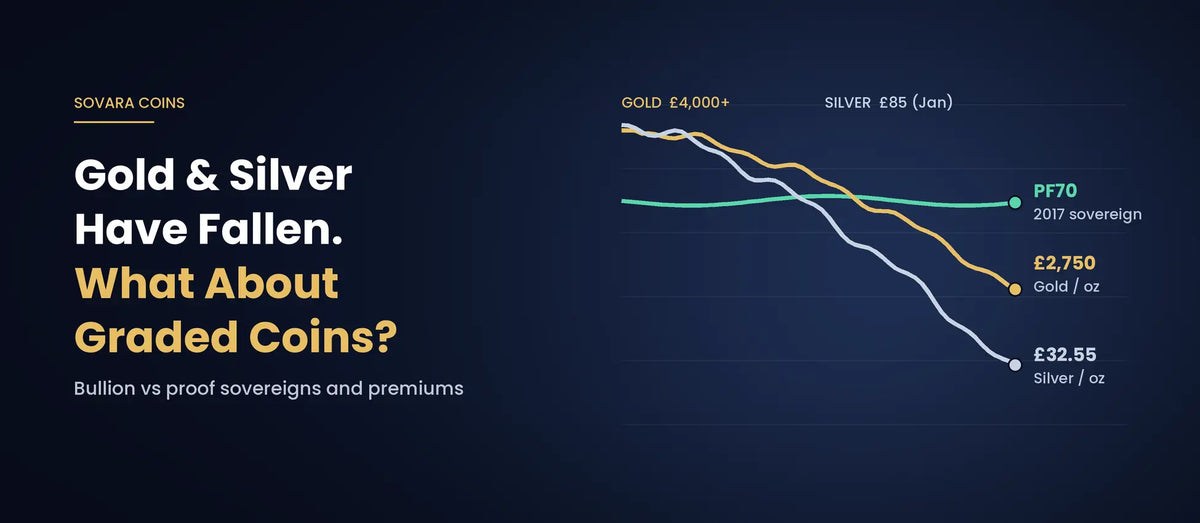
At the start of March, gold was sitting north of £4,000 an ounce. At the time of writing it's £2,750. Silver has had it even worse: £85 in January, £32.55 now.
If you hold either, or you've been watching and wondering whether to buy, that's a horrible chart to stare at. But the question I keep getting asked, and the one that matters for what we do every day, is a slightly different one. What does it do to coins that are worth a lot more than the metal inside them?
The short answer is that it depends which coin we're talking about, and a lot of people lump them all together when they shouldn't. Let's go through it properly.
Prices in this article are correct at the time of writing (23 November 2026) and spot moves every day.
Contents
- What's actually happened to gold and silver
- Bullion: yes, it's taken the full hit
- Why a graded coin isn't priced like a lump of gold
- The proof: premiums over melt, coin by coin
- Case study: the 2017 PF70 sovereign
- Silver, and why a £66 coin sells for many times that
- Where it does hurt collectors
- If you're thinking of buying or selling
- FAQ
What's actually happened to gold and silver
| Metal | Then | Now | Fall |
|---|---|---|---|
| Gold (per oz) | Over £4,000 (start of March) | £2,750 | More than 30% |
| Silver (per oz) | £85 (January) | £32.55 | Over 60% |
Those are big moves by any standard. Euronews reported last week that gold was heading for its biggest annual drop since 2015, and the reasons they give are fairly dull ones, which is part of the point. The US Federal Reserve raised rates in September for the first time since 2023, and the market expects another rise in December. US bond yields are around 5%, the dollar has been at its strongest since April 2025, and the Iran war has pushed oil and inflation up, which has made rate rises more likely rather than less.
Gold pays you nothing for holding it. When you can get 5% on a government bond, gold has to work harder to justify itself, and for now it isn't. That's a story about interest rates and the dollar. It says nothing about whether a rare coin is any less rare than it was in March.
For balance, central banks haven't walked away either. The same report points to a net 675 tonnes of gold bought by central banks and other official institutions between January and September. I'm not making a prediction either way. I just don't think it's as simple as "everyone's giving up on gold".
Bullion: yes, it's taken the full hit
Let's get the obvious bit out of the way. If you own a bullion coin or bar, you've felt it, and there's no way round that.
A full sovereign contains about 7.32g of pure gold, which is roughly 0.235oz. At £4,000 an ounce, that's about £942 of gold. At £2,750 it's about £647. The metal in a single sovereign has lost nearly £295.
Bullion coins and bars are priced at spot plus a small premium, and that's about all there is to them. There's nothing else in the price to hold them up, so they fall almost pound for pound with the metal. Same with silver bullion, only the percentages are scarier.
And a lot of the wider coin market behaves the same way, whether people realise it or not. Common-date sovereigns, ordinary bullion-grade coins and anything priced mostly for the gold in it will always track spot. If that's the sort of coin you hold, the price move is what it is.
Why a graded coin isn't priced like a lump of gold
This is where people trip up. A top-graded proof sovereign that sells for well over £1,000 isn't £1,000 of gold. It's about £647 of gold at today's price, with a much larger amount of premium on top, and that premium isn't set by the gold price at all.
What sets it is a handful of things that have nothing to do with spot:
- Grade. A PF70 is the highest grade NGC or PCGS award. A PF69 of the same coin can be a very different price.
- Population. How many have been graded at that level, and how many were struck to begin with.
- Design and history. Key dates, one-off designs, anniversary issues.
- Who wants it. Registry set builders and collectors chasing a specific date, who aren't looking at a gold chart before they decide.
The gold price still matters in two ways. It's the floor, because a coin can't realistically trade below its metal value for long. And it's sentiment: when metal is falling fast, some buyers sit on their hands. But if a coin is trading at well over its melt value, the floor isn't anywhere near it, and sentiment alone doesn't move a collector's price as fast as a spot chart does.
The proof: premiums over melt, coin by coin
Rather than just tell you this, let's look at it. The table shows some of our graded PF70 coins, the value of the gold they contain at £2,750 an ounce, and roughly how many times that value they sell for. That last column is the number I'd get most people to watch. I've left exact prices out because they change, and each coin links to its page for the current one.
| Coin (NGC PF70 Ultra Cameo) | Gold in the coin at £2,750 | Roughly how many times the gold value |
|---|---|---|
| 2013 Five Sovereign | £3,237 | About 1.5x |
| 1987 Quarter-Ounce Britannia | £688 | About 1.6x |
| 2019 Sovereign | £647 | About 1.6x |
| 2017 Sovereign (200th Anniversary) | £647 | About 1.8x |
| 1995 Half Sovereign | £324 | About 2x |
| 1989 500th Anniversary Sovereign | £647 | About 3.5x |
| 1979 Sovereign | £647 | About 5x |
Multiples are approximate, based on our listings at the time of writing and gold at £2,750.
Look at the spread. A 1979 PF70 sovereign contains exactly the same £647 of gold as a 2019 one, yet one is priced at around five times its gold and the other at under two. Gold didn't do that. Scarcity, history and demand did.
And it tells you something about risk. The coins priced at 1.5x to 1.6x are closer to metal value and so more exposed to the gold price. The ones at 3.5x and 5x have a lot of price that isn't gold, so a drop in the metal barely touches them. It's worth knowing which kind you hold, or are about to buy. Our PF70 sovereigns and wider graded collection cover the full range of both.
Case study: the 2017 PF70 sovereign
The 2017 200th Anniversary proof sovereign is the one I'd use to make this point, because I know the coin well and what it's done is telling.
It's the one with the Garter border and the date on the obverse, and NGC has graded 811 of the 12,681 struck as PF70 Ultra Cameo, with none higher. It's a key date, and it sells for a healthy premium over its gold.
That price has barely moved in several years. When gold ran up to £4,000, the coin hardly noticed. It never took off with the metal, which tells you the price was never really being set by the metal in the first place. So I can't see a good reason it should now fall in line on the way down.
Look at what's actually changed. At £4,000 gold, the gold in that sovereign was worth about £942, so at today's price the coin would have been sitting at only around 1.3 times its metal. At £2,750 the gold is worth about £647, and the same coin is at about 1.8 times. The coin didn't get dearer. The metal underneath it got cheaper.
Silver, and why a £66 coin sells for many times that
The silver side proves the same point even more strongly, because silver has fallen further and its coins carry even less metal.
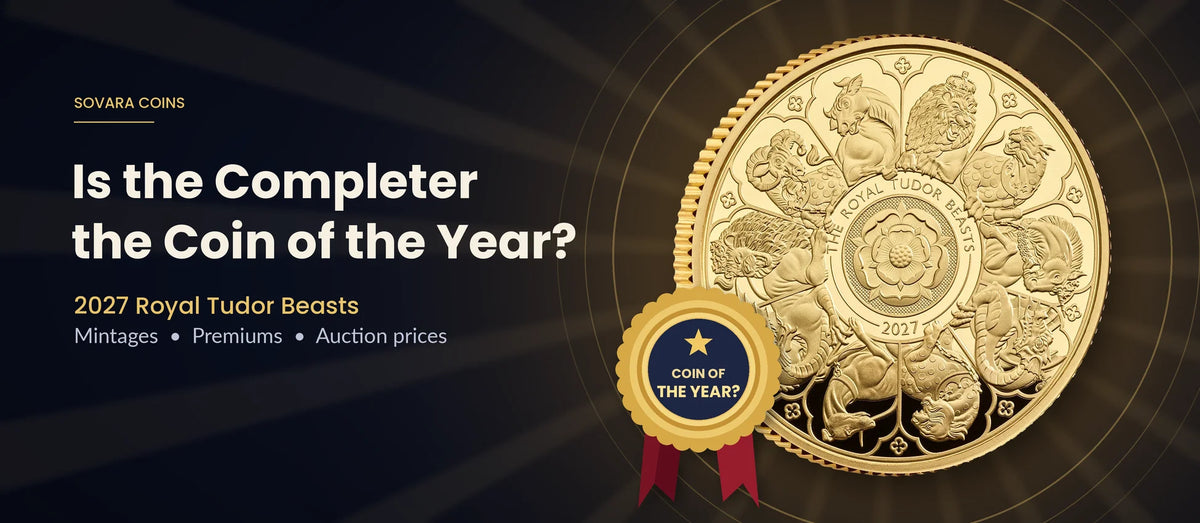
Take the 2027 Royal Tudor Beasts Completer 2oz silver proof. It contains about 2.02oz of fine silver. At £32.55 an ounce, that's roughly £66 of silver. We list the boxed coin at well over ten times that. It was issued by The Royal Mint at £325 and sold out on release day, and its price has nothing to do with the silver in it. It's about an edition of 750 and a lot of collectors who missed out. I went through how the demand played out in our piece on whether the Completer is the coin of the year.
Silver fell by well over half this year and a coin like that doesn't care, because the silver was never what you were paying for.
Where it does hurt collectors
I'm not going to tell you collectible coins are immune, because they aren't. There are three places I'd expect some pain.
Coins priced close to melt. If a coin is only a little over its metal value, it will follow the metal down. That includes plenty of modern graded gold that isn't particularly scarce. It's a collectible in name but trades mostly as metal.
Fewer buyers at any given moment. When metal drops fast, people hesitate. Some wait for the bottom, some lose interest, and some find their budget has shrunk. The coin's value doesn't have to change for it to take longer to sell. If you need to sell in a hurry in a quiet market, you'll feel it.
Anything bought at a hype premium. If you paid a high premium for something common because gold was rising and the story sounded good, that premium was resting on sentiment, and sentiment has gone elsewhere.
And to be straight about the case I made above: a price that's held for years can still change. Static isn't a guarantee. I just think the logic for a scarce, top-graded coin falling because spot fell is a lot weaker than most people assume.
If you're thinking of buying or selling
I'm not going to tell you what to do with your money, and none of this is financial advice. A few practical points, though.
If you want to own the gold price itself, bullion is the cleanest way, because that's exactly what it tracks. If you want to own something rare, the gold price is a poor guide to when to buy it. What you're paying for is a grade, a population and a design, and those don't change with the chart. One thing to remember is that British sovereigns are legal tender, so gains are exempt from Capital Gains Tax for UK residents. That's general information, not tax advice.
If you're selling, be careful who you sell to. A dealer who prices everything by weight will value that 2017 PF70 sovereign as about £647 of gold, when the coin is worth far more than that to a collector. That gap, hundreds of pounds on this one coin, is the premium you'd be handing over for nothing. I wrote a whole piece on why selling proof and graded coins to big bullion dealers is throwing money away, and it's more relevant now than ever. If you'd like a straight valuation, send us the details.
Looking at graded or proof coins?
Browse our Seventy Select (every coin PF70 or MS70), the more affordable Value Select, or our boxed proof coins. Not sure how grading works? Read our guide to NGC and PCGS graded gold, or get in touch and ask me directly.
FAQ
Why have gold and silver prices fallen?
According to Euronews, it comes down to a strong US dollar, bond yields of around 5%, a Fed rate rise in September and expectations of another in December. Higher rates make a metal that pays no interest less attractive, and the Iran war has pushed oil and inflation up, which has made further rate rises more likely.
Will graded coins fall as much as gold and silver?
Not necessarily, and often not at all. Coins priced mainly for their metal will follow spot. Rare, top-graded coins are priced by grade, population and collector demand, so spot has much less influence on them. The most useful number is the multiple of metal value the coin is priced at: the higher it is, the less the metal price matters.
What is a premium over melt value?
It's the amount a coin sells for above the value of the precious metal in it. A sovereign holding £647 of gold that sells for £1,200 has a premium of about £550, or around 1.9 times its melt value. (Illustrative figures.)
Is it a good time to buy gold coins after the fall?
We can't give financial advice, and nobody can say where gold goes next. What we can say is that bullion follows the gold price closely, while rare graded coins are priced mostly on scarcity, so the gold price is a poor signal for when to buy one of those.
Are proof sovereigns exempt from Capital Gains Tax?
British sovereigns are UK legal tender, so gains on them are exempt from Capital Gains Tax for UK residents. This is general information rather than tax advice.
Should I sell my graded coins to a bullion dealer?
Usually not. Bullion dealers tend to price by weight, which means you'd lose the premium that makes a graded coin worth more than its metal. A specialist who understands grading will normally pay far more for a scarce graded coin.