The 2023 Coronation Coins: Why Charles III's Crowned Portrait Could Be the Sleeper of His Reign
Most people who own a 2023 Coronation coin know roughly what it is: a nice commemorative piece marking King Charles III's coronation. Fewer realise it carries something The Royal Mint itself has only used a handful of times in the last three and a half centuries - a portrait of the monarch actually wearing a crown.
That detail, combined with mintages that are already low and a secondary market that hasn't caught up yet, is why we think the 2023 Coronation range - and the 1oz gold proof coin in particular - deserves a closer look than it's currently getting.
Contents
- What makes the coronation portrait different
- A genuinely rare moment in British coinage history
- The 2023 Coronation range at a glance
- Selling for not much of a premium - for now
- Why "not much of a premium" might not last
- Spotlight: the 1oz gold proof Coronation coin
- Final thoughts
- FAQ
What makes the coronation portrait different
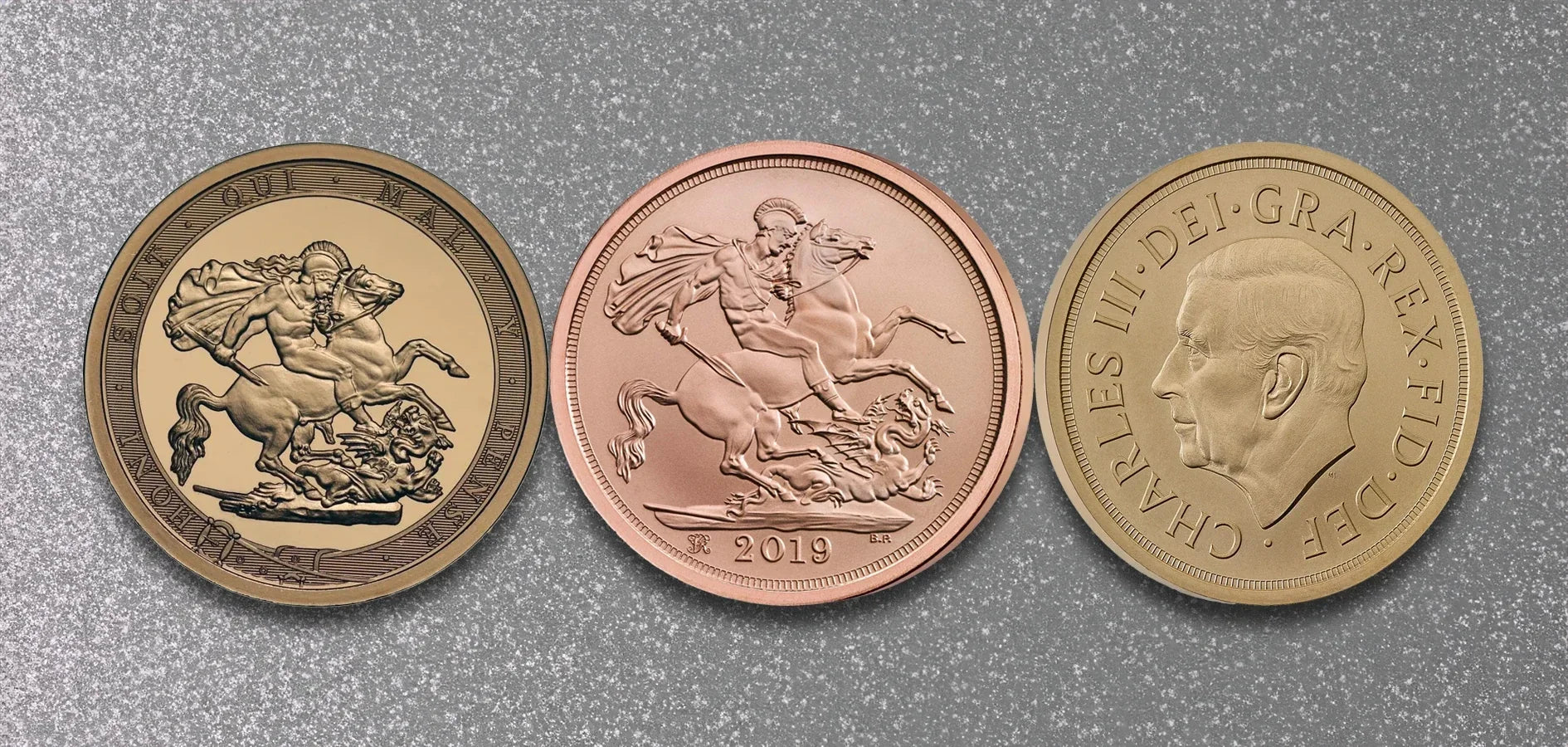
Every King Charles III coin you're likely to have handled - the sovereign in a proof set, the Britannia in a bullion tube, the 50p in your change - carries the same effigy: an uncrowned, left-facing portrait by sculptor Martin Jennings, unveiled shortly after the King's accession in September 2022 and used as the standard "definitive" portrait across circulating and investment coinage ever since.
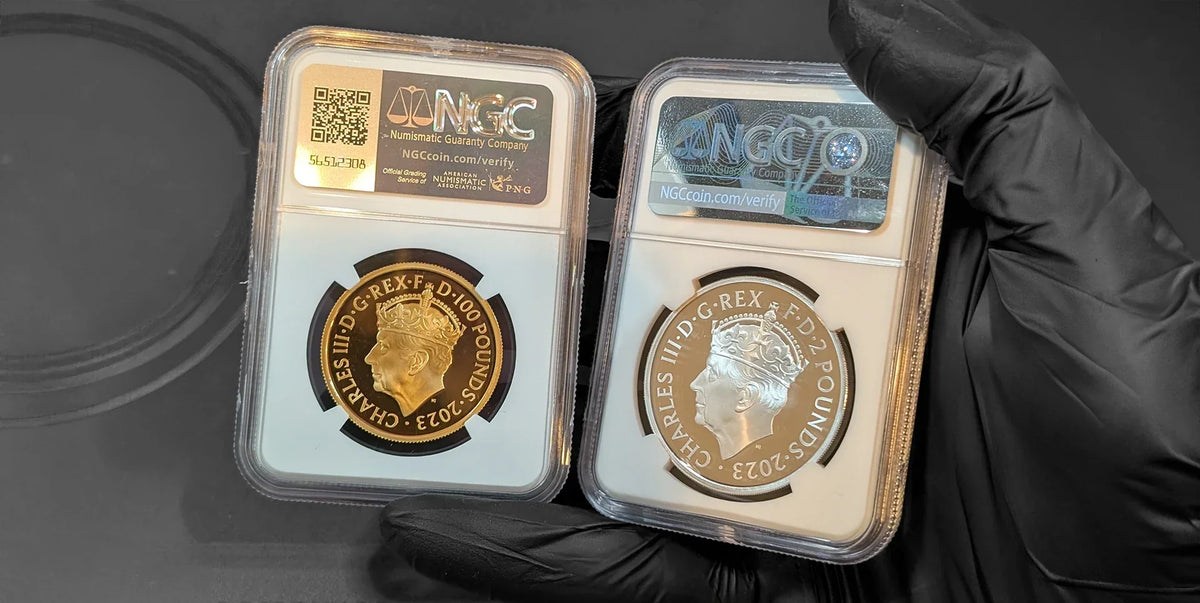
The 2023 Coronation range is different. For that collection only, Martin Jennings created a second, entirely separate portrait of the King - this time wearing the Tudor Crown. The Royal Mint's own announcement was explicit about how deliberately limited this was intended to be: "the crowned effigy is reserved specifically for collectable, commemorative coins and will be reserved for very special collections moving forwards." This isn't the everyday King Charles III portrait with a crown added for decoration - it's a purpose-built, one-off design that The Royal Mint has effectively said it doesn't intend to reuse casually.
A genuinely rare moment in British coinage history
To understand why that matters, it helps to know how rare a genuinely crowned portrait is on British coinage. Henry VIII and Elizabeth I both appeared crowned during the Tudor period. After the Civil War and the Restoration of the monarchy, British kings and queens settled into portraits showing either a laurel wreath or a bare head - a look that held for the better part of two centuries. Queen Victoria broke that pattern from the 1840s onwards, appearing in various crowns across her long reign. But her male successors - Edward VII, George V and George VI - reverted to uncrowned portraits on their British coinage, even though crowned versions of some of these kings did appear on coinage struck for territories like Jersey, India, Hong Kong and East Africa.
Elizabeth II's coinage never fully broke that pattern either. Across her seventy-year reign she had five standard UK coin portraits - by Mary Gillick, Arnold Machin, Raphael Maklouf, Ian Rank-Broadley and Jody Clark - and each one shows her wearing a wreath, tiara or diadem, not a full crown. The Royal Mint and coin dealers have described Charles III's 2023 coronation portrait as the first time a UK monarch has worn an actual crown on a British coin effigy in over 350 years - male monarchs, specifically, have been shown crownless on UK money since the era of Charles II.
The crown itself adds another layer of interest. Charles III personally selected the Tudor Crown for his coronation portrait rather than St Edward's Crown (the physical crown used to crown him at Westminster Abbey, which does appear on the reverse of the Coronation £5 coin). The Tudor Crown is a heraldic design rather than a specific surviving object - the original was destroyed in the 1640s during the Civil War period - but it has been used in royal heraldry and on commemorative portraits of kings throughout the 20th century, and now forms part of Charles III's own royal cypher.
The 2023 Coronation range at a glance
The commemorative range went on sale at 9am UK time on 24th April 2023, ahead of the coronation itself on 6th May 2023 - the first coronation of a British king in 85 years. It's worth being clear about which coins actually carry the crowned portrait, because not everything from 2023 does:
| Coin | Portrait | Notes |
|---|---|---|
| 2023 circulating 50p (5 million minted) | Uncrowned | Entered general circulation later in 2023, separate from the commemorative range |
| Coronation commemorative 50p | Crowned | Westminster Abbey reverse by Natasha Jenkins |
| Coronation Crown / £5 coin | Crowned | Reverse by Timothy Noad featuring St Edward's Crown |
| Coronation Sovereign (gold proof) | Crowned | Official maximum mintage of 15,000 |
| Coronation 1oz gold proof coin | Crowned | Official maximum mintage of 685; reverse by John Bergdahl |
| Coronation 2oz gold proof coin | Crowned | Around 300 struck in standard proof, according to official sales figures |
| Coronation 2oz gold matte proof | Crowned | Only 106 reportedly struck; roughly 23 known graded PF70 |
| Coronation 1oz silver proof coin | Crowned | Official maximum mintage of 17,500 |
Every crowned-portrait coin in that list, regardless of denomination or metal, carries the same one-off Martin Jennings design - which means the total number of coins ever struck with this portrait is a genuinely finite, closed set.
Selling for not much of a premium - for now
Here's the part that surprises people: despite everything above, Coronation Sovereigns generally haven't commanded a big premium on the secondary market. After an initial run-up tied to launch demand, premiums on proof Coronation Sovereigns settled back down to roughly the same levels as other modern proof Sovereigns, well below the elevated premiums seen on the 2022 Elizabeth II Platinum Jubilee Sovereign. In practical terms, that means it's currently possible to buy a coin carrying a portrait style not used on British coinage in over three centuries for close to what you'd pay for a standard-design proof Sovereign from any other recent year.
Why "not much of a premium" might not last
We'd argue that gap - genuine historical significance on one side, ordinary pricing on the other - is exactly the setup that tends to close over time in this market, and history backs that up.
The most extreme example is Edward VIII's 1937 pattern sovereign. Because Edward abdicated before his coinage entered production, only a handful of examples survived a 1937 melting order - six are known to exist today, most held by museums. One of the two privately held examples sold at auction for a record £1 million in 2020, and a related Edward VIII pattern piece later sold for $2.28 million, becoming the most expensive British coin ever sold. That's an extreme case driven by near-total destruction rather than low mintage alone, but it illustrates the principle: coins tied to a specific, unrepeatable moment at the start or end of a reign can go on to command enormous premiums once the wider market recognises what they represent.
A more directly comparable example is what happened to Elizabeth II coinage after her death in September 2022. Demand for coins bearing her portrait increased noticeably in the months that followed, and coin dealers reported that pieces from the very beginning and the very end of her seventy-year reign - 1953 and 2022 specifically - were expected to see the strongest long-term collector demand, alongside low-mintage commemorative designs generally. The pattern that emerges from both examples is the same: coins tied to the defining moments of a reign - its start, its milestones, and eventually its close, whenever and however that time comes - are consistently the ones the market ends up caring about most, often only once that reign is being looked back on as a complete chapter rather than an ongoing one.
The 2023 Coronation range sits squarely in that category. It marks the opening ceremonial milestone of Charles III's reign, it carries a portrait design The Royal Mint has explicitly said is reserved for special use rather than routine reuse, and every version of it was struck to a mintage that counts in the thousands or low tens of thousands at most - genuinely low figures next to standard annual Sovereign production. None of that guarantees future performance, and we're not making price predictions. But the combination of a closed, historically rare design and current pricing that doesn't yet reflect it is precisely the setup that has rewarded patient collectors with previous reigns' milestone coins.
Spotlight: the 1oz gold proof Coronation coin
If you want exposure to the crowned portrait without the cost of the 2oz coin or a full boxed Sovereign set, the 2023 Coronation of King Charles III 1oz Gold Proof Coin is arguably the most accessible way in. Struck in a full troy ounce of 999.9 fine (24-carat) gold to an official maximum mintage of just 685, it carries the same crowned Martin Jennings portrait as the rest of the range on the obverse, paired with John Bergdahl's Royal Arms design on the reverse.
Our own example is certified NGC PF70 Ultra Cameo - the highest grade numerically achievable - and holds confirmed Top Pop status, with only 118 examples graded at that flawless level worldwide against the coin's 685-piece maximum mintage. For a coin that carries a portrait style not used on British coinage in over 350 years, that's a meaningful amount of scarcity stacked on top of an already rare design.
View the 2023 Coronation 1oz Gold Proof Coin
Final thoughts
The 2023 Coronation range doesn't need much dressing up to be interesting - a crowned monarch's portrait genuinely hasn't appeared on British coinage in living memory, and The Royal Mint has said as much itself. What makes it worth writing about now, rather than simply admiring in hindsight, is that the current market hasn't fully priced that rarity in yet. Whether that changes next year or takes another reign entirely to play out, it's the kind of coin worth having in a collection before the story around it is finished being written.
Interested in the crowned Coronation range?
We carry graded examples from across the 2023 Coronation collection, alongside our full range of sovereigns and proof sets.
Shop the 1oz Gold Proof Coronation Coin | Shop Graded Sovereigns | Contact Sovara Coins
FAQ
Is King Charles III shown wearing a crown on all his coins?
No. The standard King Charles III portrait used on circulating coins, sovereigns and Britannias is uncrowned. The crowned portrait was created specifically for the 2023 Coronation commemorative range and, per The Royal Mint's own statement, is reserved for special collectable use rather than everyday coinage.
How rare is a crowned monarch's portrait on British coins?
Genuinely rare. After the Restoration, British monarchs were shown either bare-headed or wearing a laurel wreath for around two centuries. Queen Victoria was shown crowned from the 1840s, but her male successors reverted to uncrowned portraits on UK coinage, and Elizabeth II's five standard coin portraits used wreaths, tiaras and diadems rather than a full crown. Charles III's 2023 coronation portrait is widely described as the first time a UK monarch has worn an actual crown on a British coin in over 350 years.
What crown does Charles III wear on the coronation coin?
The Tudor Crown - a heraldic crown design personally selected by the King, distinct from St Edward's Crown that was physically used to crown him at Westminster Abbey (which appears instead on the reverse of the Coronation £5 coin). The Tudor Crown also features in Charles III's royal cypher.
What was the mintage of the 2023 Coronation 1oz gold proof coin?
The Royal Mint set an official maximum mintage of 685 coins for the 1oz gold proof Coronation coin.
Are 2023 Coronation Sovereigns worth a big premium right now?
Not particularly, at least not yet. Premiums settled back down to roughly the same level as other modern proof Sovereigns after initial launch demand, well below the elevated premiums seen on the 2022 Elizabeth II Platinum Jubilee Sovereign. That's part of why we think there's a gap between the coin's historical significance and its current market price.
Is this article predicting a specific price rise?
No. We're making a historically grounded case - based on how coins tied to major reign milestones have performed after previous reigns concluded - rather than a prediction about timing or value. Past performance of other coins and reigns is not a guarantee of future results.